
The Future of Retail Will Be Won in the Infrastructure Layer
At Wharton, retail operators and AI infrastructure builders converged on the same conclusion: the next retail winners will pair taste with systems.
Retail is not entering an AI era because one tool got better. It is entering an AI era because every layer of the stack is changing at once.
At a recent Wharton panel on the future of retail, that was the real takeaway.
On March 19, 2026, the Wharton School and its Baker Retailing Center brought together a panel that made that shift unusually legible: Neil Blumenthal (co-CEO) of Warby Parker, Stacey Bendet (CEO and creative director) of Alice + Olivia, John Imah (founder and CEO) of SpreeAI, and Anita Beveridge-Raffo (head of retail and consumer goods) of Palantir. On paper, those worlds look separate. In practice, they are converging fast.
That matters. The first blog post on this site argued that the internet is getting a second mode: one for humans, one for agents. Retail is where that stops being abstract, and you could hear it in the conversation.
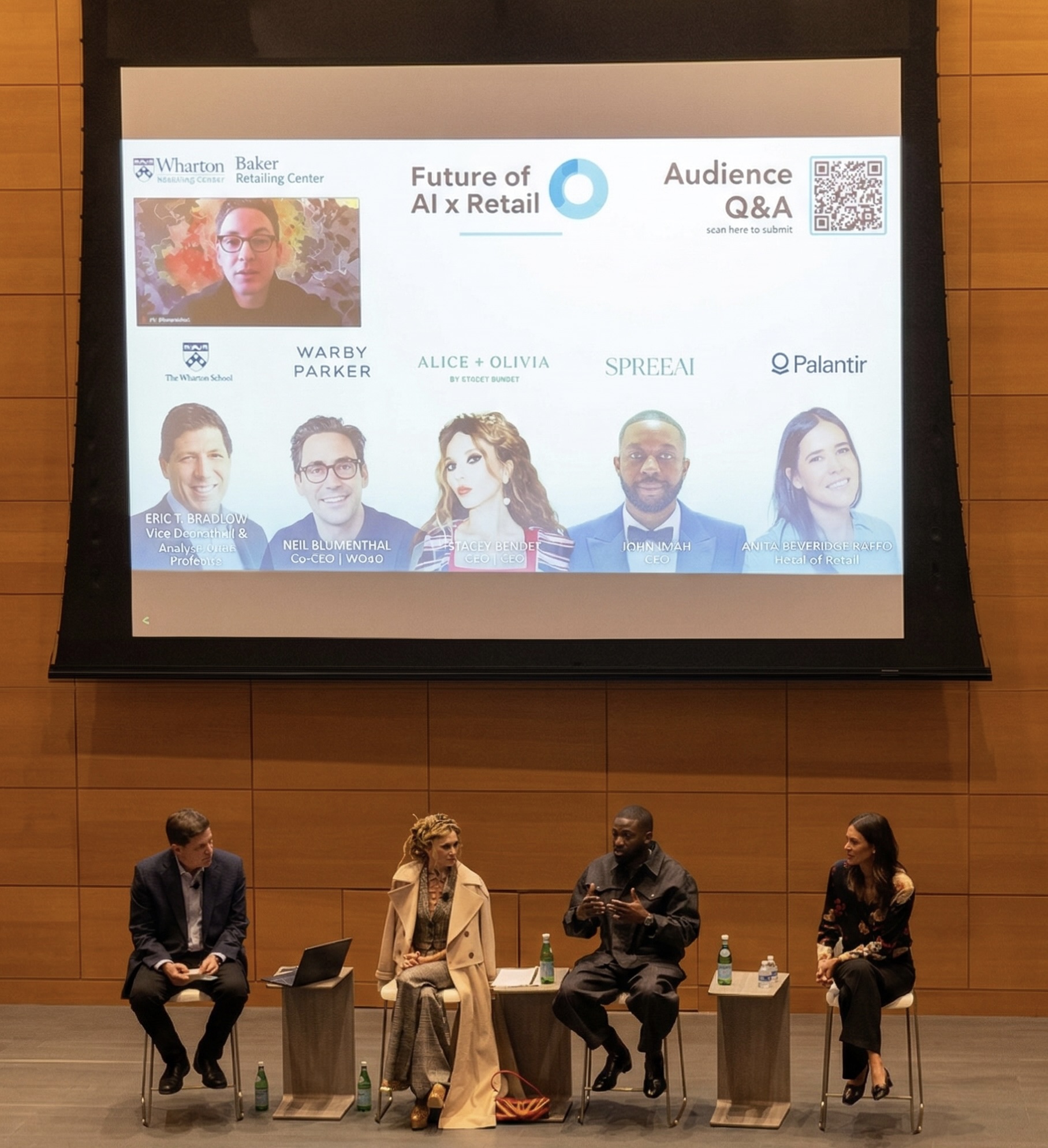 Left to right: Eric T. Bradlow, Stacey Bendet, John Imah, and Anita Beveridge-Raffo.
Warby Parker talked about AI glasses, virtual try-on, computer vision in eye care, and productivity gains across the business. The context matters: Warby already operates more than 300 stores, has distributed more than 20 million pairs of glasses through its social-impact program, and is now working with Google on Android XR glasses with Gemini.
Alice + Olivia talked about AI in design, merchandising, imagery, and internal workflows. Stacey Bendet has been building the brand since 2002, and Alice + Olivia now spans more than 350 points of distribution globally, which makes this less like edge experimentation and more like operating-model change at scale.
SpreeAI talked about fitting AI into both e-commerce and physical stores. The company was founded in 2023, and by 2025 company materials described it as having reached a $1.5 billion valuation. That pace alone is a signal.
Palantir talked about the least glamorous but maybe most important layer: making retail data usable enough for AI to act on. Its own materials emphasize digital twins in ontology-driven workflows and consumer-facing applications built on operational data, which is exactly where many retailers are still weakest.
Different companies. Same direction. Retail is becoming an infrastructure problem.
The stack is collapsing into one system
For years, retail technology was easy to mentally separate. One bucket was customer experience: storefronts, stores, checkout, merchandising. Another was operations: planning, allocation, inventory, forecasting, logistics. A third was brand: creative direction, campaigns, product design, storytelling.
AI is collapsing those buckets.
The panel made that clear. The interesting shift is not that AI can generate copy, or render product images, or answer questions. The interesting shift is that it now affects the full loop:
The Retail AI Loop
That is not one workflow. That is the business.
And once AI touches the full loop, the question changes. It is no longer: where can we insert AI? It becomes: what parts of the company are still operating as if AI does not exist?
AI in retail is not one thing
One of the most useful aspects of the Wharton discussion was that nobody described AI as a single tool.
That is how most companies still talk about it. They say they are “using AI,” when what they usually mean is that one team is experimenting with ChatGPT. That is not transformation. That is software usage.
What came through on this panel was a more serious view. AI in retail now shows up in at least four different forms.
Product.
Warby Parker’s framing was especially useful here: AI is not just an internal efficiency layer. It can become the product itself. Smart glasses are the obvious example, but the broader point is more important: some categories will be redefined by AI-native hardware and software. Google’s Android XR roadmap already names Warby Parker as one of its first eyewear partners, which makes this less speculative than it would have sounded even a year ago.
Experience.
Spree AI’s position sits here. Virtual try-on, sizing, assisted shopping, in-store clienteling, wardrobe intelligence. The point is not novelty. The point is reducing friction in purchase decisions.
Operations.
This is where companies like Palantir matter. Retailers do not suffer from a lack of dashboards. They suffer from fragmented systems, stale data, and slow decisions. AI only works once the organization can actually reference the truth of its own business.
Creativity and execution.
Alice + Olivia’s examples were important because they showed where many operators are still psychologically stuck. Designers and marketers often frame AI as a threat to originality. But used correctly, it does the opposite: it removes low-value production work and expands the number of creative directions a team can test. That is easier to believe from a founder who still serves as the brand’s creative center than from a generic software vendor selling “AI for design.”
Those four categories are different. But they reinforce each other.
That is why retail adoption will not look like one giant AI launch. It will look like many smaller changes that gradually fuse into a new operating model.
The winners will combine taste with systems
This was probably the most important theme of the panel.
AI will not eliminate taste. It will increase the premium on it.
The reason is simple. Models can compress labor. They can accelerate iteration. They can help produce options. They can surface patterns. They can automate routine decisions. But they still require direction.
Those are not model questions. Those are judgment questions.
That is why the most convincing comments on stage were not utopian. They were operational. The strongest panelists were not saying AI replaces people. They were saying it changes where people add value.
The companies that understand this will move faster than the companies still organizing around a false choice between “human creativity” and “AI efficiency.”
That is not the tradeoff. The new advantage is human taste amplified by machine speed.
Retail still has an integration problem
This is where the conversation got more honest than most AI panels.
A lot of retail AI demos look impressive because they sit on top of clean, narrow, controlled examples. The real retail environment is messier.
That is the actual terrain.
Which means the bottleneck is often not the model. It is the integration layer.
If not, you do not have an AI system. You have an expensive interface.
That is why infrastructure matters so much.
In the first post, we described OIAT: Observability, Integration, Analytics, and Trust. The Wharton panel was effectively a retail-specific case study in why those four pillars matter.
Most companies are still weaker on those foundations than they think.
Physical retail is not going away
Another useful correction from the panel: AI is not making stores irrelevant. It is making the store more hybrid. That distinction matters.
For a long time, retail technology discussions were framed as online versus offline. But AI does not respect that boundary. A customer may discover a product online, try it on virtually, inspect it in store, buy later, reorder from a different channel, and expect the system to remember all of it.
That is one journey, not four. The same is true on the retailer side. In-store associates, merchandising teams, and e-commerce managers are increasingly operating on the same decision surface.
The future store is not a repudiation of the internet. It is a node in a larger AI-mediated retail system.
That is why the most interesting in-store use cases are not gimmicks. They are coordination tools.
Physical retail survives by becoming more intelligent, not by remaining untouched.
The real split is cultural
Every panel on AI eventually arrives at technology. The better ones also arrive at management. This one did.
The biggest divider in retail over the next few years will not be company size. It will not even be budget.
It will be whether leadership treats AI as a side tool or as a company-wide operating shift. That sounds obvious. It is not.
Most organizations still delegate AI “experimentation” downward while keeping the real operating model unchanged. One team pilots something. Another team ignores it. A third worries it is a threat. No one redesigns incentives, workflows, or decision rights.
Then they conclude the technology is immature.
Sometimes it is. Often the organization is.
The panel kept returning to a sharper point: the companies that move first are usually the ones where leadership has already decided the change is real.
That matters more than the exact tool choice.
Because once that decision is made, the rest of the company starts asking the right questions:
That is when AI adoption stops being theater.
What this means now
If you are a retailer, the takeaway is not “go buy AI.”
The takeaway is more demanding.
If you are a founder, the opportunity is also clearer than most people think.
Retail does not need more generic AI. It needs tools that fit the existing economic structure of the industry: margins, returns, inventory risk, seasonality, visual merchandising, associate workflows, customer trust. The panel itself was evidence of that. Warby Parker is approaching AI from product and eye care. Alice + Olivia is approaching it from creative and merchandising velocity. SpreeAI is approaching it from shopping interfaces and try-on. Palantir is approaching it from decision infrastructure.
And if you are watching the broader market, the Wharton panel made one thing hard to ignore:
Retail is becoming one of the clearest real-world proving grounds for applied AI.
Not because it is fashionable, but because it is measurable.
That is where abstract enthusiasm has to become operating reality.
The future of retail is not one tool
It is a stack: models, workflows, interfaces, data systems, brand choices, and human decisions.
The companies that win will not be the ones with the flashiest demo.
They will be the ones that understand how all the layers connect. That is what the Wharton panel made visible. The future of retail will not be built by AI alone. It will be built by retailers and infrastructure companies that know where AI belongs.